

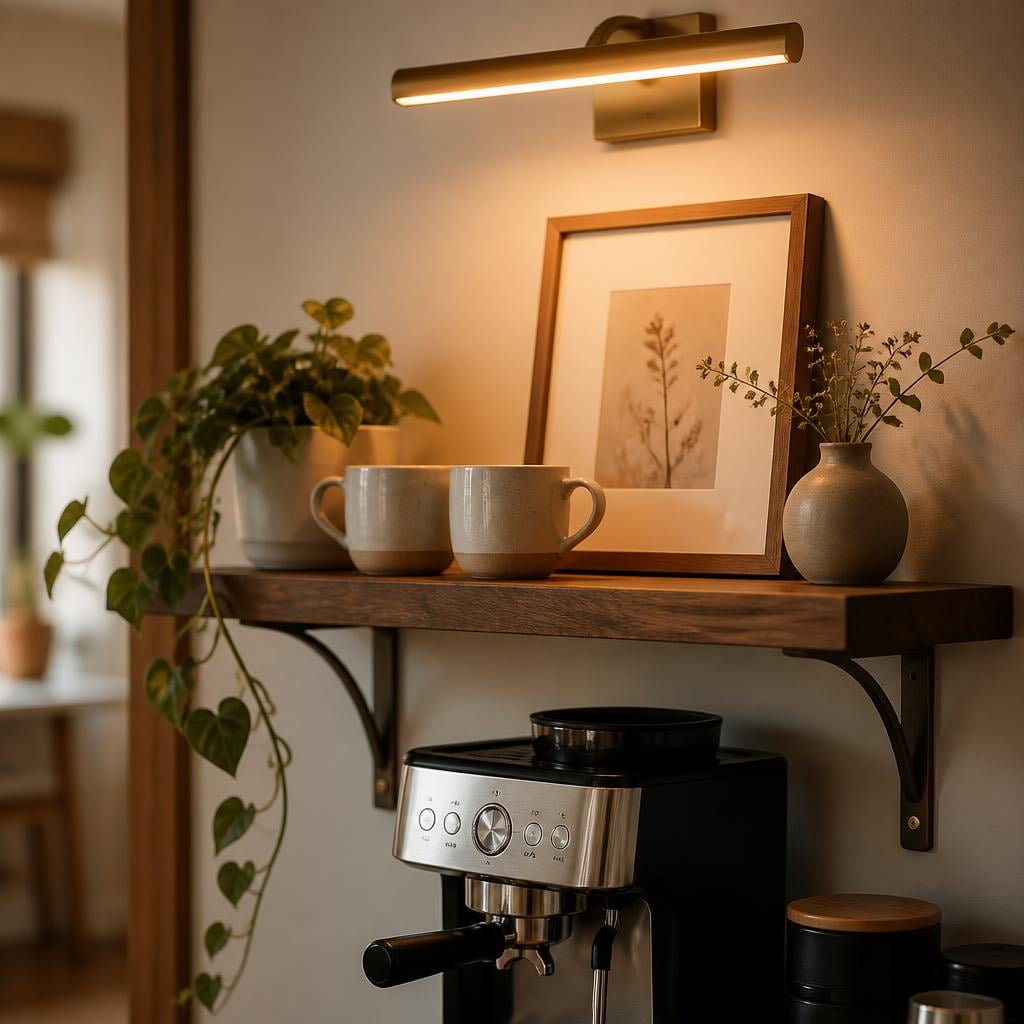
A good trinket shelf has one tall thing, one wide thing and a few small things, arranged in groups of three with a hand’s width of empty shelf between the groups. Put the everyday cups on it so it earns its place, light it with a warm bulb, and edit it once a month. That is the whole method; the rest of this guide is how to get there.
Why the shelf above the coffee station
The wall above a coffee station is the most looked-at fifty centimetres in most kitchens. You stand in front of it every morning while the kettle heats, and it is the first thing guests see when you offer them a coffee. It is also where the cups need to be, which means it already has a job. A shelf that holds two useful things and three beautiful ones never reads as clutter, because half of it is there for a reason.
“Curated clutter” and trinket shelves have been all over Pinterest this year, and the difference between the ones that look charming and the ones that look like a shop display is editing. Every object on a good shelf can be explained: it is used, it was found somewhere, or it was made by someone.
Pick the anchor first
Every shelf needs one object that sets the tone, and it should go up first. A framed print, a ceramic vase, a vintage tin, a small painting leaning against the wall. Put it slightly off centre, about a third of the way along, not dead in the middle. Everything else is arranged in relation to it, and a shelf with a clear anchor looks composed even before the small things arrive.
If you are stuck, the anchor is usually the biggest thing you own that you like looking at. Frame a postcard from a café you loved. Lean a small chopping board. The anchor does not have to be expensive; it has to be the thing your eye goes to first.
The rule of three
Objects in odd-numbered groups read as intentional. Pairs read as symmetrical and stiff, and rows of four look like a shop. Group a cup, a small plant and a candle. A bud vase, a stone and a matchbox. Then leave a hand’s width of empty shelf before the next group.
The gaps are the part people skip. A shelf with no visible shelf is a cupboard with the door off. On a 60 cm shelf that means two groups, maybe three; on a 90 cm shelf, three groups and the anchor.
Mix heights and materials
Within each group: one tall, one medium, one low. Across the shelf: wood, ceramic, glass, and one metal. If everything is the same height the eye slides straight past; if everything is white the shelf disappears into the wall. A trailing plant does a lot of work here because it adds a vertical line and a bit of green that nothing else on a coffee shelf provides.
| Height | Examples |
|---|---|
| Tall | bottle, tall vase, framed print, plant in a pot |
| Medium | cups, a small jug, a candle, a stack of two books |
| Low | a dish, a stone, a coaster, a tin, a tiny bowl of beans |
Books are underrated shelf objects. Two cookbooks stacked flat with a cup on top gives you height and a base in one move.
Let the cups live there
The two mugs you use every morning belong on this shelf, not in a cupboard. They are the reason the shelf exists, they never gather dust because they are always in use, and displayed objects that are also useful never feel like clutter. Add a small jar of filters or a bean canister and the shelf is doing real work for the station below it, which keeps the counter clear for brewing.
Choose the cups with the shelf in mind. Handmade stoneware in one glaze family looks calmer than a rainbow of mugs from different trips; keep the novelty mugs for the cupboard and bring one out when you feel like it.
Light it
Lighting is the difference between a shelf and a corner. Options, cheapest first:
- A battery picture light clipped to the shelf edge, warm white, 2700 K, on a timer for evenings. Rechargeable ones last a week between charges.
- An LED strip stuck under the front edge of the shelf, pointing down at the station. This also lights the brewing, which is genuinely useful at 6 a.m.
- A small plug-in lamp on the shelf itself if there is an outlet nearby. This becomes an object in its own right, so count it as your tall thing.
Avoid cool white bulbs anywhere near coffee. Warm light makes wood, ceramic and crema look the way they do in the photos; cool light makes everything look like a dentist’s waiting room.
Seasonal swaps
The shelf stays interesting if one or two things change with the season and the rest stay put. Autumn: a sprig of dried wheat or a few acorns in the low dish, and the maple oat latte in the cup. December: a small evergreen sprig in the bud vase and a string of tiny warm lights. Spring: a single stem, a lighter cup. Summer: nothing at all in the vase, and the shelf feels cooler for it.
Keep a shoebox of the off-season objects in a cupboard. Rotating things in and out is what stops a shelf from freezing into a museum display.
Edit monthly
Once a month, take everything down, wipe the shelf, and put back only what you missed while it was empty. Anything you did not miss goes in the box or to the charity shop. Then add at most one new thing.
This is the single habit that keeps curated clutter curated. Things have to leave as often as they arrive. The monthly edit also lines up neatly with descaling the kettle and cleaning the grinder, so the whole corner gets reset at once.
Common mistakes
- Too many small things and no anchor. It reads as a collection of stuff rather than a composition.
- Everything at the front edge. Push the anchor back to the wall and bring one or two small things forward for depth.
- Matching sets. Three identical candles in a row is a shop, not a home.
- Nothing living. One plant, even a cutting in a jar of water, makes the shelf feel like someone lives there.
- Buying to fill it. Start with what you own. The shelf should take a year to feel finished.
The coasters you put the cups on can be part of the shelf too; the air-dry clay coaster project makes a set that matches whatever glaze your cups are. More display and small-space ideas are in Cozy Corners.
Watch the short version
Frequently asked questions
How many things should go on a trinket shelf?
Fewer than you think. Start with five to seven objects on a 60 cm shelf and add one at a time until it feels full but not busy. If you cannot see shelf between the groups, take something off.
What about dust?
A monthly edit doubles as cleaning. Keep a soft brush by the station and give the shelf a pass when you descale the kettle. Objects you use daily, like cups, never get dusty.
Can I put the shelf above the kettle?
Yes, but leave at least 40 cm between the kettle spout and the underside of the shelf so steam does not soak the wood, and keep paper and prints to the other end.
What if I rent and cannot drill?
A freestanding two-tier counter shelf, a picture ledge on removable adhesive strips rated for the weight, or a tension shelf in a nook all work. The styling rules are the same.
Where do I find trinkets that are not junk?
Charity shops, flea markets, one piece from every trip, and things you already own that are hidden in cupboards. The best shelves are collected slowly, not bought in one afternoon.