
A jigsaw puzzle does not need to reach its final piece before the dining table returns to everyday use. The easier approach is to choose where the unfinished puzzle will rest before you begin, keep loose pieces together, and leave a short reminder of your next step.
Start with one question: will this puzzle stay on the table until it is finished, or will you need the table again? If it needs to move, assemble it on a suitable base from the beginning. A collection of joined pieces is not a rigid board. Avoid lifting it by an edge or relying on the pieces to support their own weight.
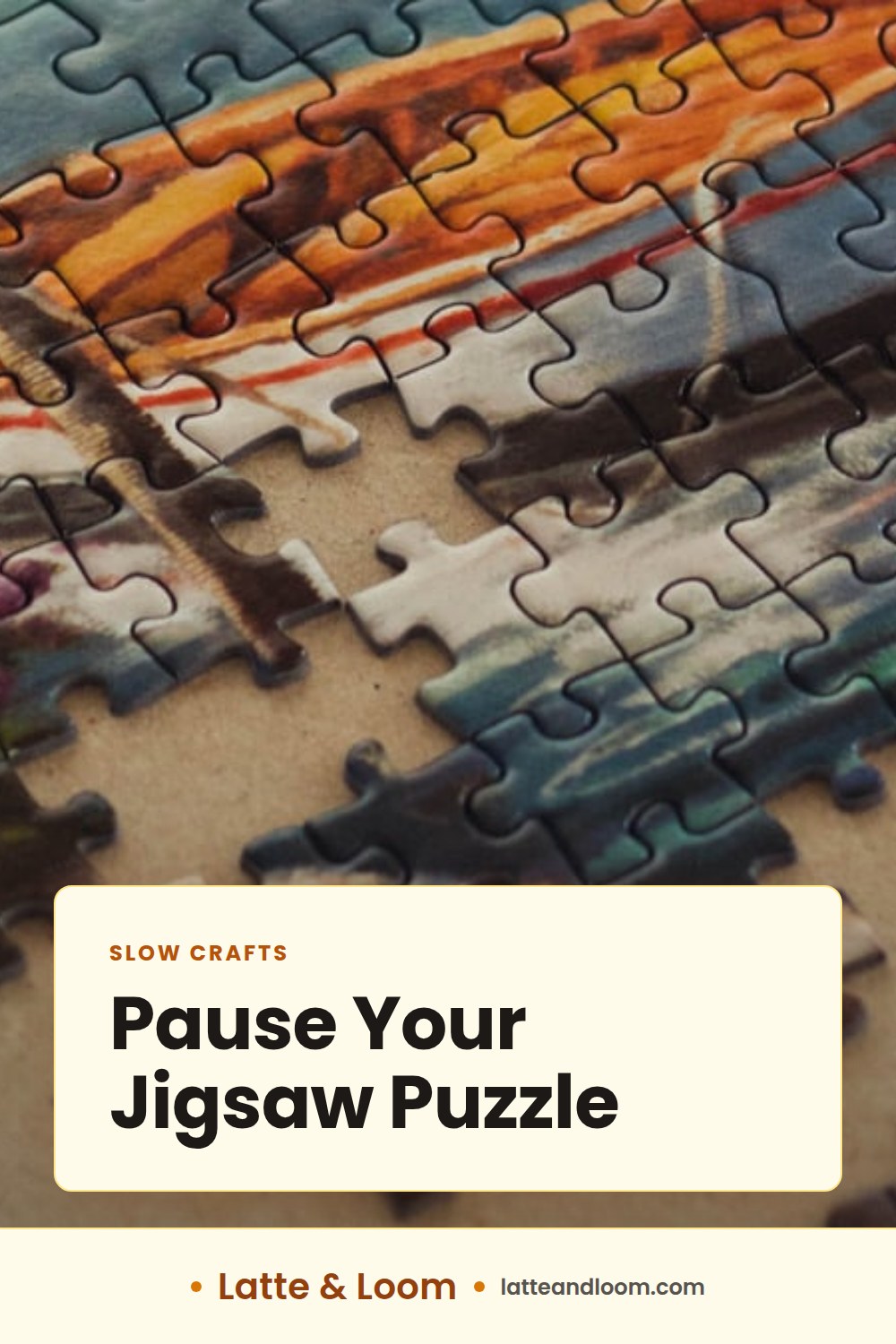
This guide covers ordinary household jigsaw sessions. The photographs illustrate puzzle pieces and work in progress. They do not demonstrate a tested storage product, a transport method or a guarantee against loose pieces.
Choose a resting place before the first piece
Pick both a working spot and a resting spot. The first needs enough room for the puzzle, a few loose-piece containers and comfortable access. The second needs to hold the chosen base without bending it or leaving an unsupported edge.
If the puzzle will stay out, agree with the people sharing the table. A small note beside it is more useful than assuming everyone knows the arrangement. Keep the puzzle away from meal preparation, and put drinks on a separate surface where reaching for a cup does not cross the pieces.
If the table needs to clear each evening, check the complete route to storage. Consider doorways, corners and the space needed to set the base down. An empty shelf is useful only if the whole base fits. Avoid precarious stacking, floor walkways and places accessible to children or pets who might disturb or swallow pieces.
Our rental-apartment cozy corner guide helps with the wider room arrangement. Here, focus on the two places the puzzle needs: somewhere to work and somewhere to pause.
Check finished dimensions, not the piece count
Read the finished width and height on the puzzle box. Compare them with the usable working area of your board, mat or case. Allow room for the complete design rather than judging from the small section you have already assembled.
Bits and Pieces’ Porta-Puzzle Caddy information advises checking puzzle dimensions rather than relying on the advertised piece count alone. The maker also recommends using that caddy on a stable table. These are useful checks even when comparing equipment you already own.
For a hypothetical example, an 18-by-24-inch finished puzzle fits within a 20-by-26-inch working area. Centering it leaves one inch on each side. Those figures do not certify a particular board: a raised rim, hinge or closure might reduce its usable space. Measure inside those features and check the product instructions.
Sorting space is separate. A base large enough for the picture might leave no room for every loose piece. Plan small containers beside it instead of spreading pieces beyond the support.
Give loose pieces a simple system
Use a few shallow, clean, dry containers you already have. Choose containers suitable for the pieces and your storage place. Avoid anything with gaps through which pieces might fall, and do not assume a loosely balanced lid will stay closed during movement.
Choose only enough groups to help your next session. You might separate the border, lettering and a distinctive color. Label a container with a short description if its purpose will be unclear tomorrow. There is no need to sort every shade before enjoying the puzzle.
Keep joined sections on their supported working surface. Put unrelated loose pieces in their own containers rather than balancing them on top of completed areas. This leaves fewer objects to shift when you return.
If several people participate, agree on the labels. One person’s landscape group might be another person’s blue pieces. A shared description prevents unnecessary resorting and keeps a short session from turning into an inventory exercise.
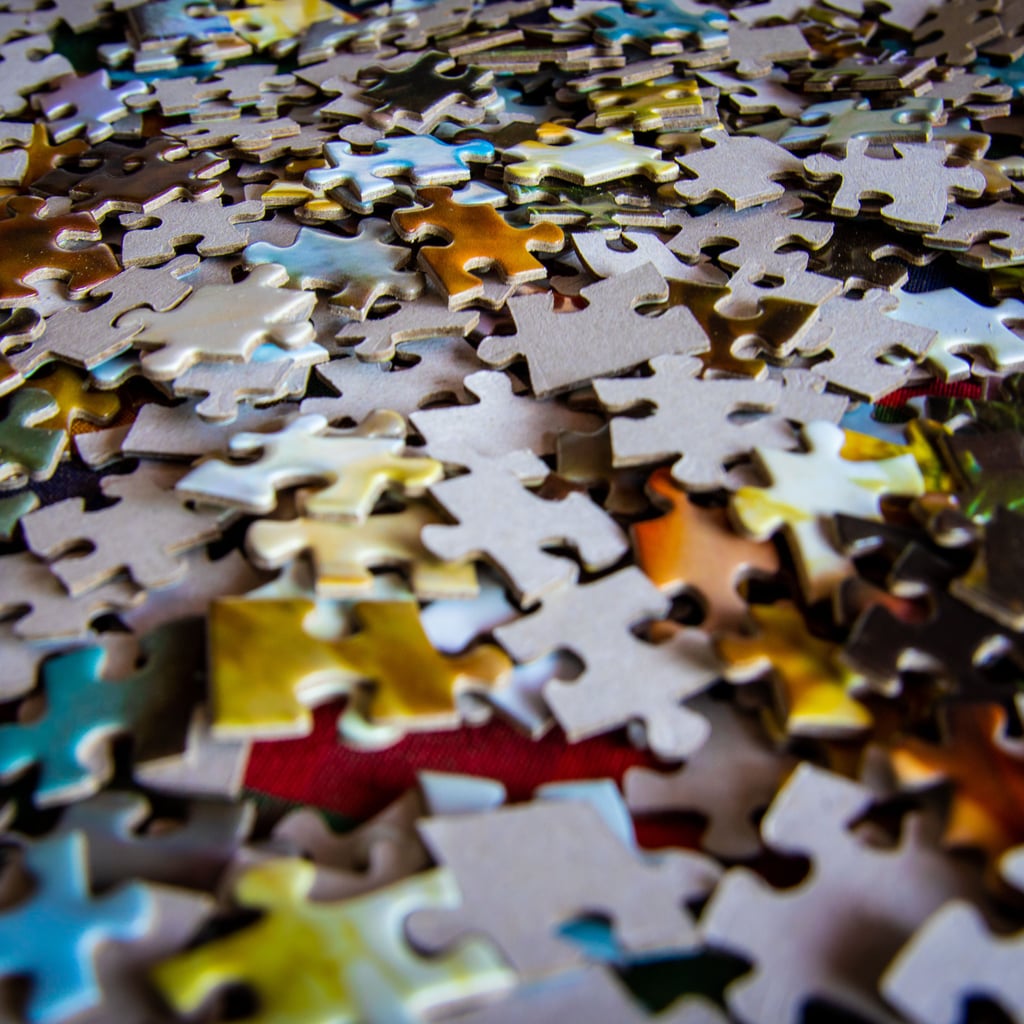
Photo: Magda Ehlers on Pexels. These loose pieces illustrate the sorting task, not a storage or transport system.
Match the pause method to your equipment
A rigid base, a closing puzzle case and a roll mat solve different problems. Use the instructions for the item in front of you. A feature described for one product is not evidence about an ordinary household board.
For a plain rigid base, plan supported, level storage. Do not assume a sheet laid over the puzzle grips the pieces or makes vertical carrying suitable. If the arrangement would need tilting, bending or carrying a large unsupported span, choose a different resting place before starting.
Ravensburger describes its Puzzle Store & Go as a system with sorting compartments, a puzzle base and a closing lid. The maker gives an upright-retention claim for that particular product. Do not transfer the claim to another case or improvise the closure from a photograph.
The same maker’s Roll your Puzzle XXL instructions describe building directly on the supplied felt, then using its inflatable tube and bands for rolling and storage. This is a purpose-made system. It does not mean an unfinished puzzle on a dining table should be rolled in an ordinary blanket.
If you already started directly on the table, avoid trying a transfer method with the entire assembly. Leave it where it is while you consult the instructions for suitable equipment. If clearing is unavoidable and no supported transfer is available, taking the puzzle apart is preferable to attempting a move you cannot control.
Use a short stopping sequence
A repeatable pause is easier than collecting pieces while another person waits to use the table. Try this sequence before leaving the session:
- Move drinks and snacks away, then check your hands and work area are dry.
- Look around the working edge and nearby floor for stray pieces.
- Return loose pieces to their agreed containers without piling them over joined sections.
- Leave joined sections supported and make a brief note of the next area you wanted to try.
- Close containers or the puzzle system according to their instructions. Check nothing obstructs a lid or closure.
- Put the supported puzzle and containers in the planned resting place using the method permitted for that equipment.
An optional reference photograph helps record where you stopped. It is a reminder, not a substitute for keeping the pieces physically together. Include the box image and container labels in your storage plan so you are not searching for them during the next session.
Make returning straightforward
Bring the work back to a stable surface before opening storage. Check the base and closures, then open them as instructed. Keep the same orientation if it helps you recognize the section you were working on.
Read your short note before emptying containers. Set out one group, try a few pieces and leave the remaining groups contained. You do not need to recreate a large spread for a ten-minute session.
If you prefer another small table activity between puzzle sessions, our guide to starting a junk journal with existing supplies offers a separate project. Keep paper scraps and adhesive supplies away from the open puzzle so the two activities remain easy to put away.
After the next pause, adjust the part which caused trouble. Perhaps a container needs a better lid, the storage opening is too narrow, or the working base needs more support. Solve that specific problem before buying a larger organizing system. The useful result is a puzzle you know how to leave and return to, with your household table ready for its next use.
Frequently asked questions
Is a plain board safe to carry upright?
Do not assume it is. Keep an ordinary supported base level. Follow the instructions for any purpose-made case and its permitted storage orientation.
Should I roll a puzzle I started on the table?
A roll mat is a specific system intended for building on its own surface. Follow its instructions instead of rolling a bare puzzle in household fabric.
Does a 1000-piece label prove a puzzle fits my case?
No. Compare the finished puzzle width and height with the usable working area, including any limits from rims, hinges or closures.
Photo credits
Photo (pin 1): Levent Simsek on Pexels, Pexels License
Photo (pin 2): Levent Simsek on Pexels, Pexels License
Photo (inline 1): Magda Ehlers on Pexels, Pexels License