
AI disclosure: This article was drafted with AI assistance and reviewed by our editor before publishing. Learn more.
Yes — a burr grinder for French press is generally worth it if you want steadier extraction, cleaner flavor, and less grit in the cup. If you’re happy with coarse, forgiving results and low cost (or you rarely brew), a cheap blade grinder or preground beans will work. The decision comes down to how much you care about consistency, time, and money.
Direct answer: yes, but with caveats
Why a burr grinder helps with French press
A burr grinder produces a much narrower spread of particle sizes than a blade grinder. For a French press that uses coarse grounds and immersion brewing, fewer fines (very small particles) means less over-extraction, less bitterness, and less sediment in the cup. You’ll taste clearer fruit and chocolate notes and get a more repeatable result from batch to batch.
When a burr grinder isn’t worth it
If you brew one cup a week, are satisfied with the taste, or need the absolute cheapest option, a burr grinder may not be worth the upfront cost and upkeep. Very inexpensive burr grinders (under about $50) can still produce uneven coarse grinds; you start seeing meaningful improvements above that point.
How to decide based on your setup and budget
- If you brew French press daily and care about flavor: buy a burr grinder.
- If you brew occasionally and want a low-cost boost: consider a hand-crank burr grinder ($30–$80), like the Timemore Chestnut C3.
- If budget is tight but you want electric convenience: aim for an entry-level electric burr in the $100–$200 range, such as the Baratza Encore, for noticeable improvements over blades. If you’re choosing between a manual and an entry-level electric, read a hands-on comparison such as Baratza Encore vs Timemore C3: Which First Grinder?.
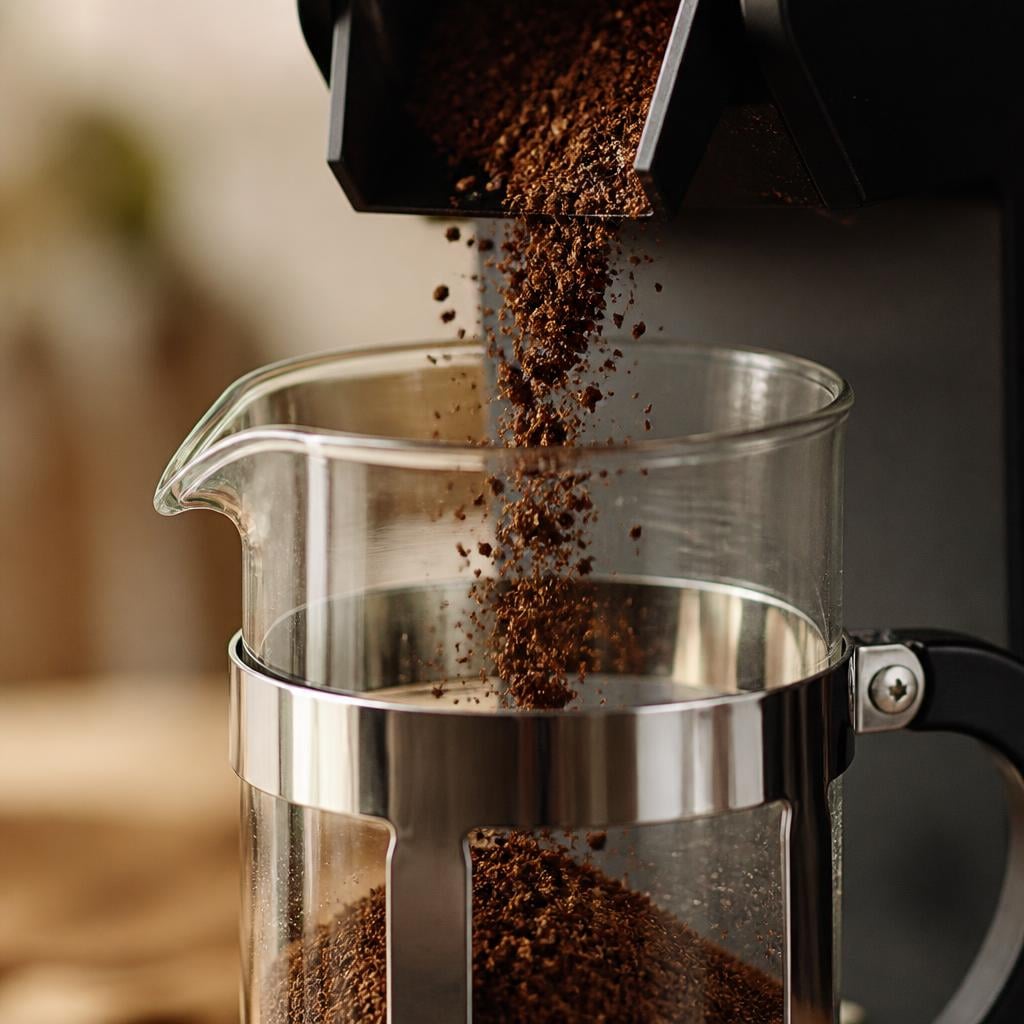
What a burr grinder does for French press coffee
Grind particle size consistency
Burrs crush beans between two abrasive surfaces to create more uniform particle sizes. That uniformity reduces extremes: fewer fines (which extract quickly and add bitterness) and fewer oversized chunks (which under-extract and taste thin). For immersion methods like French press, consistency matters less than for espresso, but it still trims off the rough edges.
Impact on extraction and flavor
More uniform grounds mean extraction pulls more of the desirable flavors and less of the bitter or astringent compounds. With a burr grinder you’ll get:
- Cleaner cup clarity.
- More predictable strength for a given dose and brew time.
- Less sediment if you stop grinding at a true coarse setting.
Maintenance and long-term costs
Expect to clean the grinder weekly (5 minutes) and do a deeper cleaning monthly (15–30 minutes). Burrs wear slowly; a household burr set can last years before replacement is needed. Plan for occasional replacement parts or professional servicing if you choose a motorized model.
Blade grinders vs burr grinders for French press
What’s the practical difference in grind
Blade grinder: chops erratically, producing a wide range of particle sizes — fines and chunks mixed together. Burr grinder: produces a concentrated band of particle sizes with far fewer fines.
Table: Blade vs Burr — practical comparison
| Feature | Blade grinder | Burr grinder |
|---|---|---|
| Particle consistency | Wide spread; many fines | Narrower spread; fewer fines |
| Typical price | $15–$40 | $40–$600+ |
| Impact on French press | More sediment, less clarity | Cleaner, more repeatable cup |
| Noise & mess | Loud, messy (chaff, static) | Varies; less static with some models |
| Ease of use | Simple, no settings | Needs dial/setting but repeatable |
How each type affects brew time and taste
Blade grinders create fines that extract quickly and muddy the cup, often pushing you to shorter brew times or coarser doses to compensate. Burr grinders let you set a coarse target and maintain a 3.5–5 minute steep time reliably, producing fuller body without excessive bitterness.
Noise, mess, and ease of use
Blade grinders are noisy and can fling grounds; they also generate static that makes a mess. Burr grinders vary: conical burrs often run quieter and create less static, while flat burrs can be louder but finer for some settings. Most burrs have catch bins and dosing features that cut down mess.
How to choose a burr grinder for French press
Key specs to look for
- Coarse grind capability: clearly marked settings that handle coarse/press grind.
- Stepless or fine-click adjustment: stepless gives micro-tuning, click-style gives repeatable stops.
- Burr size: household grinders with burrs ~40 mm+ generally produce steadier coarse grinds.
- Low retention: removable hopper and grounds chute to reduce leftover coffee.
- Build & easy cleaning: removable burrs or tool-free access for monthly cleaning.
Dosing and workflow tips
- Weigh beans: 20–30 g for a single 12–16 oz press, depending on strength.
- Grind just before brewing to preserve aroma — grind time in an electric burr takes 5–10 seconds for a single dose.
- Use a cup-to-kettle workflow: beans → grinder → press → kettle → brew, so grounds go straight to the press.
Budget-friendly picks and mid-range upgrades
- Manual burr grinders ($30–$80): good for low-cost, low-noise, low-energy households; faster burrs cost more. See the Timemore Chestnut C3 for a practical example.
- Entry electric burrs ($100–$200): decent consistency for French press without breaking the bank. The Baratza Encore sits in this class.
- Mid-range ($200–$400): better motors, larger burrs, timed dosing and lower retention for regular brewers.
Brewing guidelines that pair with a burr grind
Grind size target for French press
Aim for a coarse to medium-coarse grind — like sea salt to coarse kosher salt. If your grinder has numbered settings, this is often toward the coarser third of the range.
Water temp, brew time, and agitation
- Water temperature: 195–205°F (90–96°C).
- Brew time: 3.5–5 minutes; 4 minutes is a reliable starting point.
- Agitation: gentle stir once after 30–45 seconds to wet grounds evenly, then place lid with plunger up.
Tuning your grind to your kettle and press method
If your coffee tastes weak, make the grind slightly finer or increase dose by 1–2 grams. If it’s bitter or over-extracted, coarsen the grind by one or two clicks or reduce brew time by 30 seconds.
Data points you can trust (practical numbers)
dataPoints — quick reference table
| Parameter | Practical number |
|---|---|
| Typical brew ratio (coffee:water) | 1:12 to 1:16 (common starting point 1:15) |
| Water temperature | 195–205°F (90–96°C) |
| Brew time | 3.5–5 minutes (start at 4:00) |
| Grind setting (descriptor) | Coarse to medium-coarse (sea salt → coarse kosher) |
| Single-serve dose | 14–20 g beans for 8–12 oz cup |
| Small press (12–16 oz) dose | 20–30 g beans |
| Entry electric burr price range | $100–$200 |
| Mid-range electric burr price | $200–$400 |
| Manual burr price range | $30–$80 |
| Weekly cleaning time | ~5 minutes |
| Monthly deep cleaning time | 15–30 minutes |
Consistency benefits of burr grinders
Expect fewer fines and a tighter particle distribution, which translates to less sediment, more control over extraction, and a cleaner-tasting cup. Those benefits are most noticeable if you brew regularly and compare side-by-side.
Common pitfalls and trade-offs
Over-investing early
Buying a $600+ grinder before you know you’ll brew daily is a common mistake. Start with a manual or entry electric model until you know what you use most.
Hunting for perfect consistency vs. real-world taste
It’s easy to chase tiny improvements in grind uniformity while missing simple gains like fresher beans, correct water temp, and proper dose. Taste first; optimize second.
Maintenance time and cost
A quality grinder adds a small regular chore: weekly knock-out of grounds and occasional burr cleaning. Expect occasional replacement parts over years, but not frequent high costs for typical home use.
Brewing stepList (a quick French press workflow)
- Heat water to 195–205°F (90–96°C).
- Weigh 20 g coffee and 300 g water for a 1:15 ratio (adjust to taste) or use the Brew Ratio Calculator.
- Set burr grinder to coarse/medium-coarse and grind directly into the press.
- Pour 60 g water to bloom 30–45 seconds, then add remaining water.
- Stir gently once, place lid with plunger up, brew 4 minutes.
- Slowly press and pour immediately.
If you want a straightforward next step: pick a manual grinder if you need low cost and don’t mind a few extra minutes of effort, or an entry electric if you want speed and consistency with minimal fuss. I started with a hand grinder and moved up when I needed faster mornings; that’s a common, sensible path.
Watch the short version
Frequently asked questions
Is a burr grinder essential for French press?
No. You can make decent French press coffee with preground beans or a blade grinder. A burr grinder improves consistency, reduces sediment, and clarifies flavor—especially noticeable if you brew often.
Do I need a high-end burr grinder to notice a difference?
Not necessarily. A mid-range or even a good entry-level burr grinder will show clear improvements over a blade grinder. The point of diminishing returns generally starts above $300–$400 for most home French press use.
What features matter most in a burr grinder for home use?
Prioritize coarse grind capability, easy-to-clean design, low retention, and stable adjustment (stepped or stepless). Burr size and motor power matter less than consistent settings and user-friendly cleaning.
How much does grind consistency affect the final cup in a French press?
Consistency reduces fines and under-extracted chunks; that means less bitterness and sediment and more predictable strength. The difference is noticeable but smaller than for espresso; still, consistent grinds lead to a clearer, more balanced French press.
Can I get by with a blade grinder if budget is tight?
Yes. You can improve your coffee with fresher beans, correct water temp, and tighter brewing routines even with a blade grinder. If you want an upgrade later, a manual burr grinder is an inexpensive step that yields a larger improvement than technique alone.
Tools and gear mentioned
Free tool
Coffee Brew Ratio Calculator
Coffee-to-water for pour-over, French press, AeroPress and espresso.
Open calculator